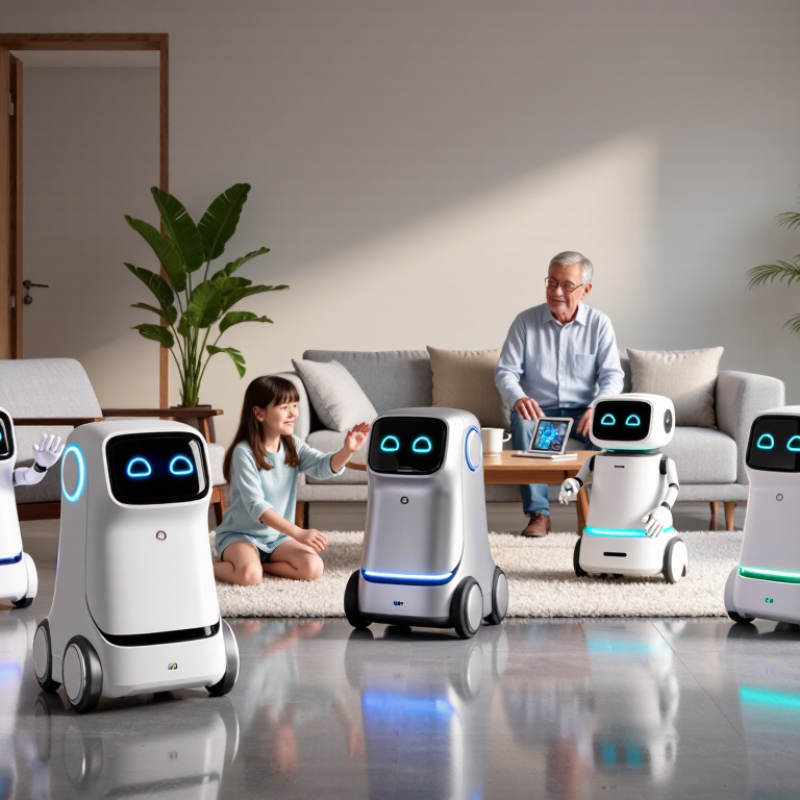
China’s AI companion robot market is moving from playful prototypes toward practical home and care experiences. Small wheeled robots now follow users across rooms, recognize familiar voices, and display expressive eyes on compact screens. Some models also support reminders, conversation, remote family contact, and basic emotional interaction.
This article examines ten leading Chinese manufacturers shaping the category. The selection considers product maturity, artificial intelligence capability, hardware reliability, privacy design, safety controls, after-sales service, and visible market adoption. Factory scale matters, but it does not tell the whole story. A polished demo can hide weak long-term support. Real household use reveals more.
Sherry Turkle, an MIT psychologist and technology researcher, once warned, “We expect more from technology and less from each other.” Her observation remains relevant to every AI companion robot. These machines may reduce loneliness, assist older adults, or encourage children to engage with learning content. They cannot replace human care, judgment, or genuine relationships.
The ranking is therefore not absolute. Public specifications vary, testing conditions differ, and some companies disclose limited information. That uncertainty deserves attention. We compare available evidence rather than repeat promotional claims. Readers should also check local data protection rules, warranty terms, software updates, and repair access before making a purchase.
China’s leading manufacturers are building an important test case for social robotics. Their progress is impressive. Their limitations are equally instructive.
What Are AI Companion Robots and Why Is China a Key Market?
AI companion robots are physical systems designed for conversation, emotional support, entertainment, and daily assistance. They may combine microphones, cameras, language models, motion sensors, and expressive faces. Unlike industrial robots, they must respond to tone, pauses, gestures, and changing routines.
China is a key market because technology access and demographic demand are developing together. The China Internet Network Information Center reported 1.092 billion internet users by December 2023, with internet penetration reaching 77.5%. Meanwhile, National Bureau of Statistics data showed that people aged 60 and above represented 21.1% of China’s population in 2023. These figures create practical scenarios, from voice reminders for older adults to interactive learning at home. The demand is real, but not always simple.
Industry data also shows a strong manufacturing foundation. The International Federation of Robotics reported 276,288 industrial robot installations in China during 2023, equal to 51% of global installations. This figure does not measure companion robots directly. It does indicate mature supply chains, engineering talent, and component access. The International Federation of Robotics also recorded about 5.1 million consumer service robots sold globally in 2023, including domestic and personal-use categories. However, companion robots remain difficult to evaluate. A friendly voice is not enough. Reliability, privacy protection, language accuracy, and long-term user trust still require careful testing. Some products may look intelligent while offering limited memory or weak emotional understanding.
| No. | Market Dimension | Verified Data | Why It Matters for AI Companion Robots | Public Source |
|---|---|---|---|---|
| 1 | Population aged 60 and above | 296.97 million people, representing 21.1% of China’s population in 2023 | A large senior population creates demand for emotional interaction, family communication, health reminders, entertainment and home-care assistance. | National Bureau of Statistics of China |
| 2 | Population aged 65 and above | 216.76 million people, representing 15.4% of the population in 2023 | Ageing-related use cases support long-term opportunities for companion robots designed for reminders, social interaction and assisted living. | National Bureau of Statistics of China |
| 3 | Internet-user base | 1.092 billion internet users and a 77.5% internet penetration rate at the end of 2023 | Connected households are more likely to use cloud-based voice assistants, remote monitoring, online content and family video communication. | CNNIC, Statistical Report on Internet Development in China |
| 4 | 5G infrastructure | More than 3.38 million 5G base stations by the end of 2023 | Strong mobile connectivity enables low-latency voice interaction, cloud AI services, remote diagnostics and software updates for connected robots. | Ministry of Industry and Information Technology |
| 5 | Industrial robot installations | 276,288 industrial robots installed in China in 2023, approximately 51% of global installations | A mature robotics supply chain can reduce development costs and improve access to motors, sensors, controllers, batteries and mechanical components. | International Federation of Robotics |
| 6 | Robot density in manufacturing | 470 robots per 10,000 manufacturing employees in 2023 | High automation density indicates strong engineering capabilities, system-integration experience and production know-how relevant to companion robot manufacturing. | International Federation of Robotics |
| 7 | National research and development expenditure | RMB 3.326 trillion in 2023, equal to 2.64% of GDP | Substantial R&D investment supports advances in artificial intelligence, speech recognition, computer vision, sensors, batteries and robotics software. | National Bureau of Statistics of China |
| 8 | Artificial-intelligence policy target | China’s plan targets an AI core-industry scale exceeding RMB 400 billion by 2025 | Policy support encourages investment in AI chips, algorithms, intelligent hardware, autonomous systems and commercial AI applications. | State Council of the People’s Republic of China |
| 9 | Smart-manufacturing adoption | China reported more than 2,500 national-level smart manufacturing demonstration factories by 2024 | Digital factories provide a suitable environment for flexible assembly, quality control, data collection and scaled production of complex robotic products. | Ministry of Industry and Information Technology |
| 10 | Core functions of an AI companion robot | Typical functions include voice dialogue, emotion-aware interaction, movement, vision, reminders, entertainment and smart-home control | These functions combine AI software with physical robotics, creating opportunities across elderly care, education, hospitality, family communication and consumer electronics. | International Federation of Robotics, Service Robots Overview |
Note: This market overview intentionally excludes company names, brand names and company-level ranking data. Figures refer to publicly reported national or industry-level information and may vary by reporting period or statistical methodology.
FAQS
Strong systems combine language models, edge processors, cameras, microphones, and motion controls. Their differences appear during real use. Small details matter.
Test the robot in a noisy room. Use children’s voices, regional accents, and interrupted questions. Ask the same question twice.
A robot lasting only three hours may become decoration. Check normal usage time, charging speed, and performance during continuous conversations.
Look for local data processing, visible recording indicators, secure accounts, and clear deletion procedures. Read the data policy carefully.
Educational models often provide structured lessons. Conversation-focused models may respond more warmly. Neither guarantees complete or dependable answers.
Check navigation sensors, moving parts, response delays, offline functions, and recovery after misunderstandings. A polished shell proves little.
Request a working sample and production records. Review quality controls, testing equipment, packaging, spare parts, and recent export experience.
Confirm minimum orders, customization fees, delivery dates, warranty coverage, and remote technical support. Clarify software ownership and product data rights.
Ask how firmware failures and discontinued components are handled. Speak with recent customers. Their experiences may challenge the supplier’s promises.
Not necessarily. A low offer may hide unstable production or unfinished features. Leave time for another testing round. Early assumptions can be wrong.
Conclusion
This article explores the development of the AI companion robot industry in China, explaining how these robots combine conversational intelligence, emotional interaction, voice recognition, sensors, and smart home connectivity to support companionship, education, entertainment, and daily assistance. China has become an important market because of its strong manufacturing capabilities, expanding AI ecosystem, diverse consumer needs, and growing interest in intelligent living. The article also presents a practical framework for evaluating manufacturers, including product reliability, software capabilities, customization options, safety protection, production capacity, certifications, after-sales service, and international cooperation experience.
It further compares ten leading categories of Chinese manufacturers without focusing on brand names, highlighting differences in appearance design, mobility, language interaction, cloud and edge computing, personalization, and target users. Finally, the article explains how to select the right supplier according to budget, application scenario, technical requirements, delivery expectations, and long-term support. This overview helps buyers understand the market and make a more informed decision when choosing an AI companion robot manufacturer.