A plush toy robot may look simple on a product page: soft fabric, stitched eyes, and a small, friendly shape. For global buyers, however, the real product includes much more—sample accuracy, repeatable stitching, clear material specifications, and dependable shipping. Details matter. Circana reported that toy sales across 12 tracked global markets declined 7% in 2023, underscoring how carefully buyers must assess cost, demand, and supplier resilience.
Market outlooks still point to opportunities. Grand View Research’s plush toys market analysis projects continued expansion through 2030, reflecting demand for comfort-oriented and character-based products. That broad category does not guarantee demand for robot designs. It does suggest why buyers should compare suppliers on more than price: fabric feel, embroidery precision, color consistency, customization options, production capacity, and sample-to-batch accuracy all affect the final result.
This guide introduces plush toy robot suppliers for buyers seeking practical, verifiable comparisons. It considers communication, lead times, customization, quality documentation, and experience serving export markets. Ask for a detailed specification sheet and a production sample. A polished sample is not proof of a reliable production line. The comparison is imperfect, too: supplier capabilities change, and public information may not show factory performance. Use each profile as a starting point, then confirm current details directly before placing an order.
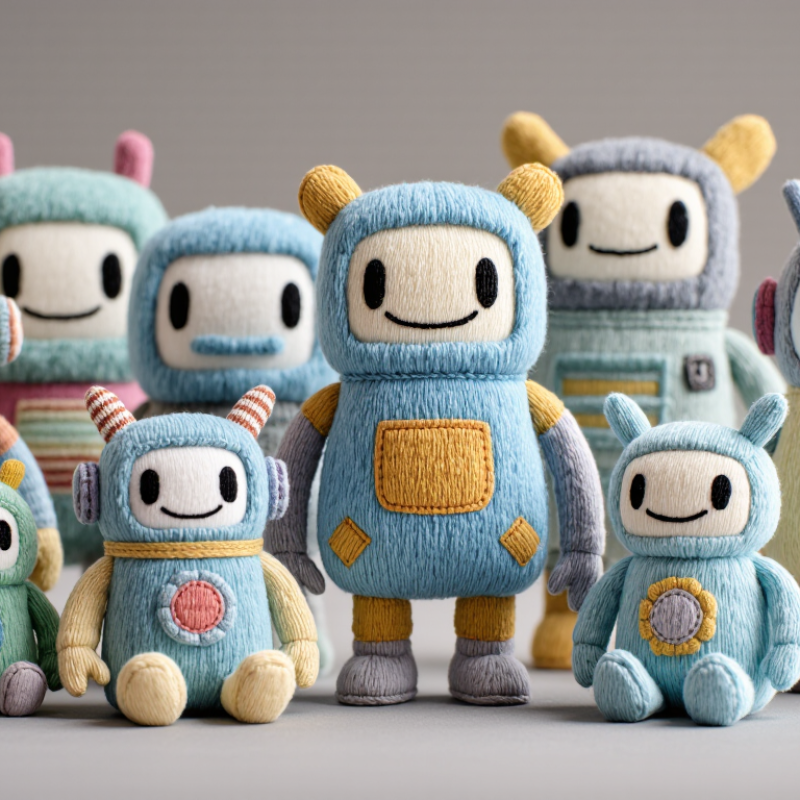
Plush Robot Toy Types, Materials, and Core Manufacturing Specifications
Plush robot toys commonly include simple character dolls, seated companions, and poseable figures with softly shaped limbs. A 15–25 cm toy fits small gift packaging, while a 30–40 cm version needs more careful seam and filling control. Details matter. Embroidered eyes and stitched control panels keep the surface soft, though they may look less sharp than molded pieces. Metallic effects can be suggested with fabric appliqués rather than stiff, scratchy trims.
Most shells use polyester plush, selected by pile length, fabric weight, and color consistency. Short pile shows clean panel edges; longer pile feels cozy but can hide stitching. Polyester fiberfill provides light, springy volume. Ask suppliers to state filling weight and shell fabric specifications, rather than relying on “soft” or “premium.” Small parts and decorative trims should be securely attached. Plush prototypes can reveal issues that drawings miss.
A practical specification sheet records finished height after stuffing, component dimensions, seam locations, stitch type, and acceptable measurement variation. There is no single tolerance that suits every design, so agree on limits before sampling. Request photos of seam checks and filling distribution during production. A gentle squeeze test helps spot thin areas, but it is not a substitute for documented quality checks. One detail is easy to overlook: dense embroidery may pucker lightweight fabric, so inspect the face closely on the approved sample.
Supplier Landscape: OEM/ODM Models, Production Capacity, and MOQ
The supplier landscape for plush toy robots depends on design ownership, production scale, and order flexibility. Grand View Research estimated the global stuffed and plush toys market at USD 11.3 billion in 2023, with projected annual growth of 7.2% from 2024 to 2030. This is a market estimate, not a factory-capacity measure. It does suggest why buyers should check whether a supplier can handle repeat orders, not just a polished sample.
OEM suppliers typically manufacture from buyer-provided drawings, materials, and specifications. ODM suppliers may offer existing patterns and help adapt features such as embroidered control panels, fabric antennas, or soft-fill body shapes. Ask for separate quotes for sampling, tooling, and production. MOQ varies with fabric color, custom components, and embroidery setup; a low quoted minimum may apply only to standard materials. Ask for the MOQ by design and color.
Capacity needs evidence. Request monthly output for similar sewn products, current lead times, and recent inspection records. Check whether cutting, stitching, stuffing, and final checks happen in-house or through subcontractors. That matters. A factory may report high output but have limited space for a new order. Grand View Research’s market figures cannot resolve that gap. Buyers should verify capacity with a pilot run and a dated production schedule. One point is easy to miss: a sample made by senior staff may not reflect routine line quality.
Global Toy Safety Standards: EN 71, ASTM F963, and ISO 8124
For buyers sourcing plush toy robots, safety begins with the finished toy, not a supplier’s general certificate. EN 71 covers mechanical and physical hazards, flammability, and migration of certain elements. ASTM F963 and the ISO 8124 series address comparable toy-safety risks, but their requirements and acceptance processes differ by market. A plush shell can hide hard seams, loose decorative parts, or an awkward battery compartment. Small details matter.
The U.S. Consumer Product Safety Commission’s 2022 Toy-Related Deaths and Injuries report estimated 209,500 emergency-department-treated toy-related injuries among children under 15. That figure covers toys broadly, not plush robots alone, but it shows why documented testing matters.
Ask suppliers for reports tied to the exact model, materials, age grade, and production version. Check seam strength, attached eyes, accessible small parts, and any electronic components; toy standards may not cover every electrical risk.
Ask for proof. A test report is useful, yet it can become outdated after a fabric, dye, or factory change. Buyers should verify which standard edition was used and whether the tested sample matches the shipped product.
That step is easy to overlook.
U.S. CPSIA Limits: 100 ppm Lead and 0.1% per Restricted Phthalate
For plush robot toys sold in the United States, CPSIA limits deserve close attention. Accessible component parts generally must contain no more than 100 ppm total lead. Each restricted phthalate must stay below 0.1% by weight in applicable children’s toys. That is 1,000 ppm per restricted phthalate, not 1,000 ppm for the group. Small parts matter.
A soft outer shell is only one part of the review. Check plastic eyes, embroidered details, printed patches, buttons, and any accessible plastic components. Ask suppliers for test reports that identify the materials tested, the methods used, and the product or batch covered. Reports from a qualified, CPSC-accepted laboratory can help verify compliance, but a report for a similar-looking toy may not cover a changed fabric or component. That detail is easy to overlook.
Keep approved material specifications and production records together. If a supplier changes thread, coating, or plastic, ask whether the change affects test coverage. No single document tells the whole story. Buyers should review the evidence against the finished toy and applicable requirements, rather than relying on a general safety statement.
Top Plush Toy Robot Suppliers for Global Buyers – U.S. CPSIA Limits: 100 ppm Lead and 0.1% per Restricted Phthalate
Supplier categories below are sourcing profiles, not named companies or verified supplier rankings. Confirm each supplier’s capabilities and product-specific compliance evidence before placing an order.
| Supplier profile |
Typical plush robot focus |
Components to review |
U.S. CPSIA benchmark |
Buyer verification steps |
| Plush-focused OEM |
Soft-bodied robots with sewn facial features, embroidered details, and fabric accessories. |
Outer fabric, thread, stuffing, embroidery, labels, and any attached plastic or metal parts. |
Lead: no more than 100 ppm (0.01%) in accessible component parts. Lead in paint or other surface coatings is limited to 90 ppm.
Restricted phthalates: no more than 0.1% (1,000 ppm) of each restricted phthalate in accessible parts of covered children’s toys and child-care articles.
|
Request a component-level materials list, applicable test reports, and change-control procedures for fabrics, trims, and suppliers. |
| Electronics-integrated plush OEM |
Robots with sound, lights, movement, or removable battery compartments. |
Circuit boards, wires, switches, battery contacts, coatings, plastic housings, and accessible decorative parts. |
Check reports against the exact production materials and model. Review battery access, small parts, and applicable electrical and toy-safety requirements separately. |
| Custom-design plush OEM |
Made-to-order characters, custom shapes, mixed materials, or buyer-specified packaging. |
All accessible materials, including soft PVC or other flexible plastics, printed details, coatings, and packaging components where applicable. |
Approve a production-representative sample and confirm testing covers the final design, intended age grading, and all accessible components. |
Restricted phthalates covered by the CPSIA limit
| Substance |
Abbreviation |
Maximum concentration |
| Di-(2-ethylhexyl) phthalate | DEHP | 0.1% (1,000 ppm) each |
| Dibutyl phthalate | DBP | 0.1% (1,000 ppm) each |
| Benzyl butyl phthalate | BBP | 0.1% (1,000 ppm) each |
| Diisononyl phthalate | DINP | 0.1% (1,000 ppm) each |
| Diisobutyl phthalate | DIBP | 0.1% (1,000 ppm) each |
| Di-n-pentyl phthalate | DPENP | 0.1% (1,000 ppm) each |
| Di-n-hexyl phthalate | DHEXP | 0.1% (1,000 ppm) each |
| Dicyclohexyl phthalate | DCHP | 0.1% (1,000 ppm) each |
Compliance note: Applicable children’s products generally require testing by a CPSC-accepted laboratory and a Children’s Product Certificate (CPC) from the responsible manufacturer or importer. Requirements depend on the product and its intended use; confirm the applicable rules and current guidance for each market.
Official references:
U.S. CPSC lead requirements |
U.S. CPSC phthalate requirements |
Children’s Product Certificate guidance
Comparing Suppliers by Quality Control, Lead Time, Cost, and Logistics
For global buyers, plush toy robot suppliers should be compared on more than quoted price. Quality control starts with clear specifications: fabric feel, seam strength, embroidery placement, stuffing consistency, and the function of any sound or light components. Ask how incoming materials and finished units are inspected, and request photos or a sample from the actual production process. A neat prototype is useful, but it cannot prove every production batch will match. Small details matter.
Lead time needs a careful breakdown. Confirm sample approval, material sourcing, production, inspection, and shipping separately. Ask what could delay the schedule, such as custom colors or changes to packaging. Compare total landed cost, not just unit cost; tooling, packaging, freight, and possible storage charges can change the calculation. A low quote may be reasonable, or it may leave important steps unclear. A spreadsheet can still mislead if suppliers define completion dates differently.
Tips: Request a written quality checklist and a dated production schedule. Compare shipping options, carton dimensions, and dispatch points. Keep one approved sample for reference, while recognizing that even good controls cannot remove every variation. A short video of packed cartons can help, but it is not a substitute for an agreed inspection.
Top Plush Toy Robot Suppliers for Global Buyers
A buyer evaluation framework comparing quality control, lead time, cost, and logistics
The chart shows illustrative priority weights for assessing suppliers, not measured supplier performance or quoted prices. Adjust the weights to reflect your product requirements, order volume, and destination market.
Conclusion
Choosing a plush toy robot supplier requires assessing product design, materials, and manufacturing capabilities together. Buyers should compare fabric softness and durability, filling options, electronic or decorative components, stitching strength, and specifications such as size, weight, and packaging. Suppliers may offer OEM or ODM services, with different production capacities, minimum order quantities, sampling processes, and customization options. Clear specifications help ensure that the finished plush toy robot matches expectations for appearance, function, and consistency.
Safety and dependable delivery are equally important. Ask suppliers how they verify compliance with relevant requirements, including EN 71, ASTM F963, and ISO 8124, and how they address U.S. CPSIA limits of 100 ppm for lead in accessible components and 0.1% for each restricted phthalate. Compare quality-control procedures, testing documentation, production lead times, pricing, shipping arrangements, and communication practices. A balanced review of these factors can help global buyers select a capable supplier and plan orders with greater confidence.